Checking a plug-in kit is compliant
Plug-in solar has been allowed in England, Scotland and Wales since 27 August 2026, for kits that meet the rules. Here's how to check one does.
Checked 4 November 2026
The ENA register
The Energy Networks Association keeps the Type Test Register, on its ENA Connect Direct site. Makers submit each kit model to it. A model you can plug in at home must show Compliant.
- Find the kit's exact model name or code on its box, datasheet or listing.
- Search for it on the ENA Type Test Register.
- Check the status says Compliant. Submitted or in progress isn't enough.
- Check the panels, microinverter and frame listed match the kit in front of you.
What compliant means
- The model is listed as Compliant on the register.
- It sends no more than 800VA (3.5A) into your home. The panels can add up to more, because the microinverter caps the output.
- It plugs straight into a wall socket. No extension leads or adaptors.
- It's used exactly as registered: no panels, inverter, lead or frame swapped.
- It isn't used with a battery.
- One kit per household, registered free at myplugin.solar before first use.
Kits with more than 960W of panels: the government's product rules say you should consider a professional assessment of your electrical installation.
The socket
Plug straight in
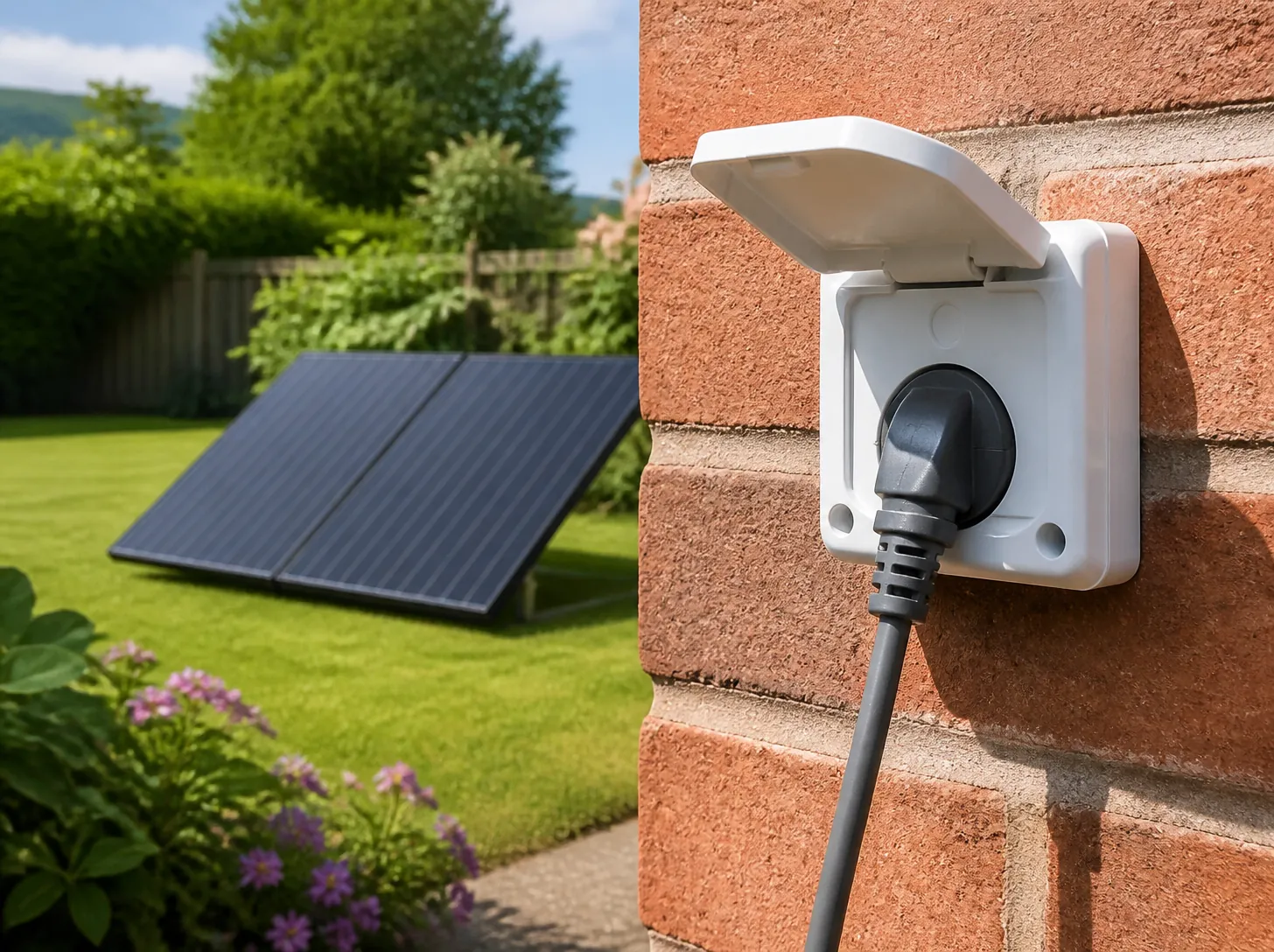
A kit plugs into a weatherproof outdoor socket within reach of its own cable. No extension leads, cable reels or adaptors.
Your home needs modern RCD protection too. If you're missing either, an electrician can fit or check them.
Our kits' listings
No model is listed yet. When one is, its page will show its ENA register reference and the date we last checked it, so you can look it up yourself.
We check the register again before any kit goes on sale.
Register your kit
Every plug-in kit is registered free at myplugin.solar before you first use it. That tells your local electricity network operator about it: Northern Powergrid in the North East, Electricity North West in Greater Manchester, National Grid Electricity Distribution in Birmingham and the West Midlands, and other operators elsewhere.
You'll need your address and the kit's make and model, as written on the box. Already have rooftop solar? Ask your network operator in writing before adding a plug-in kit.
Where kits can't go
- timber balconies, and balconies for any kit not made for them
- buildings with timber, ACM, MCM or HPL cladding
- buildings having external wall remediation
- a wall forming a boundary between properties
- anywhere it would be held with cable ties, rope or straps
Renting, leasehold or a managed building? Get written permission from your landlord, freeholder or managing agent first. Tell your home insurer too.
Sources and dates
- DESNZ: Plug-in Solar Device Interim Product Specification v2.0, July 2026
- DESNZ: Plug-in solar, government response, 16 July 2026
- GOV.UK: Plug-in solar consultation and outcome, last updated 3 September 2026
- Ofgem: decision on the G98 amendment for plug-in microgeneration, 11 August 2026
- Planning Portal: solar equipment on a house or block of flats, rules from 27 August 2026 (England)
- Energy Saving Trust: plug-in solar panel checklist, 8 October 2026
- Electrical Safety First: plug-in solar consumer guide, August 2026
Two rules are under review: one kit per household, and no batteries. Either may change. The date at the top shows when we last checked.
Is a kit on sale in a shop always compliant?
Not always. Check the exact model on the ENA register yourself before you plug it in.
Does registering cost anything?
No. It's free at myplugin.solar.
Can I use a kit in Northern Ireland?
No. Plug-in solar isn't permitted there. It's England, Scotland and Wales only.